Introduction
Identifying the poorest countries in the world requires more than comparing raw income figures. Economists rely on GDP per capita adjusted for purchasing power parity (PPP) to understand how people actually live within their local economies. PPP accounts for differences in cost of living and inflation, making it the most accurate way to compare poverty levels across countries.
In 2026, global poverty remains concentrated in regions facing conflict, weak institutions, climate stress, and limited industrial growth. This updated guide explains how poverty is measured and highlights the poorest countries in the world based on IMF 2025/2026 GDP per capita (PPP) projections.
How GDP Per Capita (PPP) Measures Poverty ?
GDP per capita (PPP) divides a country’s total economic output by its population and adjusts the result based on local purchasing power. This means a dollar is measured by what it can actually buy within that country rather than by exchange rates alone.
Why PPP matters:
- Reflects real living standards
- Accounts for inflation and cost differences
- Preferred by IMF and World Bank for poverty analysis
Top 10 Poorest Countries in the World 2026 – GDP Per Capita
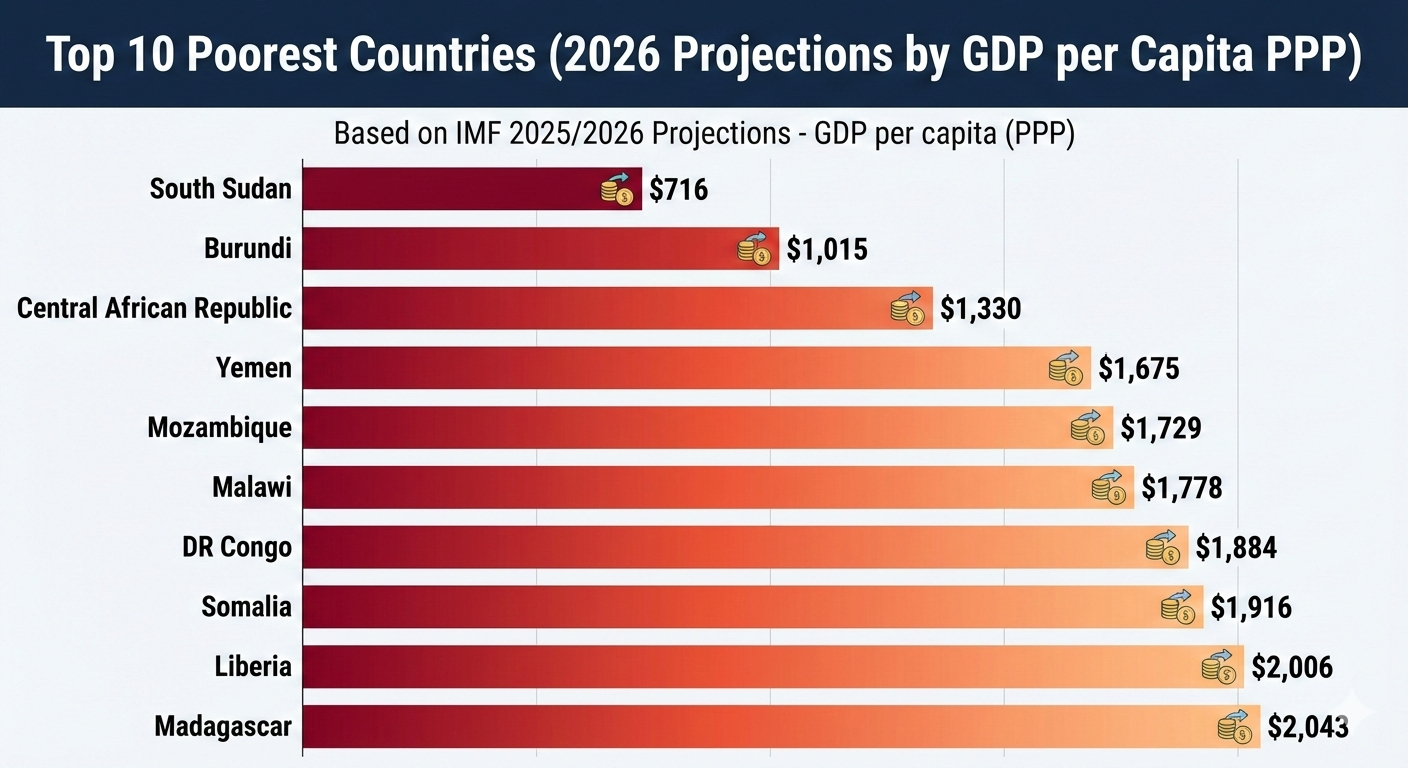
According to IMF 2025/2026 projections, the following countries rank as the poorest globally based on GDP per capita (PPP):
- South Sudan – Capital: Juba – ~$716
- Burundi – Capital: Gitega – ~$1,015
- Central African Republic – Capital: Bangui – ~$1,330
- Yemen – Capital: Sana’a – ~$1,675
- Mozambique – Capital: Maputo – ~$1,729
- Malawi – Capital: Lilongwe – ~$1,778
- Democratic Republic of the Congo – Capital: Kinshasa – ~$1,884
- Somalia – Capital: Mogadishu – ~$1,916
- Liberia – Capital: Monrovia – ~$2,006
- Madagascar – Capital: Antananarivo – ~$2,043
Poorest Countries 2026 Insights
South Sudan
South Sudan ranks as the poorest country in the world in 2026. Ongoing conflict, high inflation, weak infrastructure, and dependence on oil exports have limited economic development. Most of the population relies on subsistence farming, with limited access to healthcare and education.
Burundi
Burundi’s economy remains heavily dependent on agriculture, employing the majority of its population. Low productivity, limited industrialization, and political instability continue to suppress income growth.
Central African Republic
Persistent insecurity, poor infrastructure, and limited access to basic services have kept economic output low. Despite natural resource potential, development remains constrained.
Yemen
Years of conflict have devastated Yemen’s economy. Disrupted trade, humanitarian crises, and currency instability have significantly reduced purchasing power.
Why These Countries Remain Poor in 2026
Several shared factors contribute to persistent poverty:
- Armed conflict and political instability
- Climate-related disasters and food insecurity
- Low education and skill development
- Weak healthcare systems
- Limited foreign investment and infrastructure
These conditions often reinforce each other, slowing recovery.
Frequently Asked Questions
What is the poorest country in the world in 2026?
South Sudan is the poorest country in the world in 2026 based on GDP per capita (PPP).
Why is PPP used instead of nominal GDP?
PPP provides a more accurate comparison of living standards by accounting for differences in local prices and cost of living.
Are these rankings permanent?
No. Economic reforms, stability, and investment can improve a country’s ranking over time.
Does GDP per capita show income equality?
No. It shows average income and does not reflect income distribution or inequality.
Conclusion
The poorest countries in the world in 2026 face deep-rooted economic and structural challenges. While GDP per capita (PPP) provides a clearer picture of living standards, sustainable progress depends on peace, education, healthcare access, and long-term economic reform.
Understanding these rankings helps explain global inequality and highlights the importance of targeted development efforts worldwide.
ALSO SEE BELOW INTERESTING ARTICLES:
- Top 10 Richest Countries in the World 2026
- Top 10 Countries with highest lowest infant mortality rates 2026
- Top 10 Countries with Lowest Crime Rates in the World 2026
- Top 10 Least Educated Countries in the World 2026
- Countries With Lowest Life Expectancy Rates 2026
- Forbes Best and Worst Countries to Start a Business 2026
- Top 10 Richest Women in the World 2026
- Who is the Richest Person in the world ever