
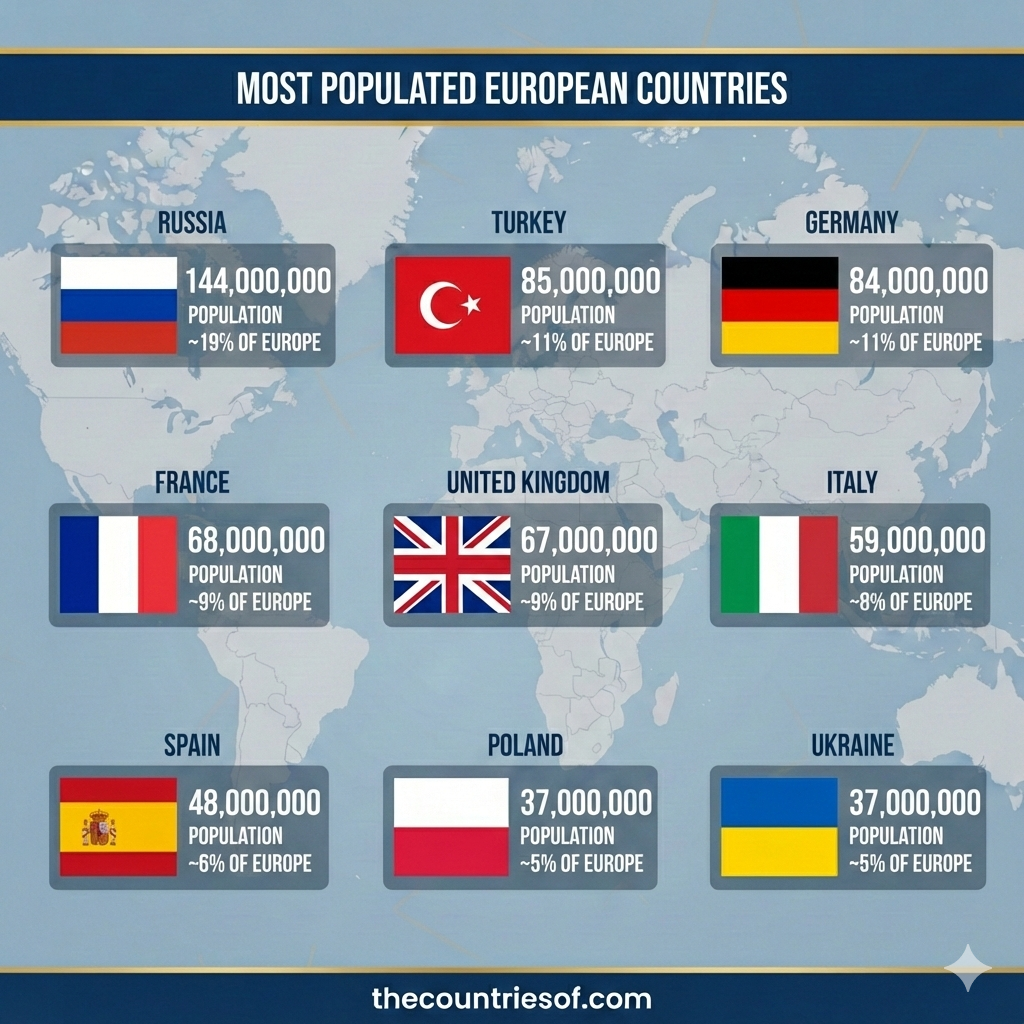
Europe is one of the most historically significant continents in the world, shaped by centuries of migration, industrialization, wars, and economic development. Geographically, Europe is traditionally separated from Asia by the Ural Mountains, Ural River, Caucasus Mountains, Black Sea, and Caspian Sea, forming a unique cultural and political region often referred to as Eurasia.
As of 2026, Europe’s total population is estimated at around 745 million people, accounting for roughly 9% of the global population. While some European countries continue to experience population growth due to immigration and urbanization, others face population decline caused by aging societies and low birth rates.
In this article, we present a fully updated list of the top 10 European countries by population in 2026, along with insights into demographic trends, migration patterns, and regional population shifts.
Note: Russia is included due to its significant population residing west of the Ural Mountains, which places a large portion of its population within Europe.
Top 10 European Countries by Population (2026)
1. Russia
- Capital: Moscow
- Estimated Population (2026): ~146 million
- Annual Trend: Slight decline
Russia remains the most populated country in Europe by a wide margin. Although Russia spans both Europe and Asia, nearly 75% of its population lives in the European part, making it the clear leader in European population rankings.
Despite long-term demographic challenges such as low birth rates and emigration, Russia’s population remains the largest due to its vast territory and urban concentration around major cities like Moscow and Saint Petersburg.
2. Germany
- Capital: Berlin
- Estimated Population (2026): ~84 million
- Annual Trend: Stable to slightly increasing
Germany is the most populous country entirely within Europe. Its population growth in recent years has been driven largely by immigration, especially from other European nations, the Middle East, and Asia.
Germany’s strong economy, healthcare system, and job market continue to attract migrants, offsetting its low fertility rate.ne of the youngest populations in the world, which contributes to its fast demographic expansion.
3. United Kingdom
- Capital: London
- Estimated Population (2026): ~69 million
- Annual Trend: Moderate growth
The United Kingdom remains one of Europe’s most densely populated and urbanized countries. London alone accounts for a significant share of population growth.
Despite Brexit-related migration changes, the UK continues to grow due to a combination of birth rates, international migration, and economic opportunities.
4. France
- Capital: Paris
- Estimated Population (2026): ~66 million
- Annual Trend: Slow growth
France has one of the highest birth rates in Western Europe, which has helped stabilize its population. Immigration also plays an important role in sustaining demographic balance.
France’s population is spread across major urban centers such as Paris, Lyon, and Marseille.
5. Italy
- Capital: Rome
- Estimated Population (2026): ~59 million
- Annual Trend: Declining
Italy continues to experience population decline due to low fertility rates and an aging population. While immigration partially offsets the decline, it has not been sufficient to reverse the trend entirely.
Italy remains one of the most culturally influential countries in Europe despite demographic challenges.
6. Spain
- Capital: Madrid
- Estimated Population (2026): ~48 million
- Annual Trend: Gradual recovery
Spain’s population declined during the early 2010s but has stabilized in recent years thanks to immigration and improved economic conditions.
Major population centers include Madrid, Barcelona, and Valencia, which continue to attract both domestic and international residents.
7. Ukraine
- Capital: Kyiv
- Estimated Population (2026): ~36 million
- Annual Trend: Declining
Ukraine has experienced significant population loss due to migration, conflict, and low birth rates. Despite this, it remains one of the most populated countries in Eastern Europe.
Population figures have fluctuated significantly in recent years due to geopolitical factors.
8. Poland
- Capital: Warsaw
- Estimated Population (2026): ~37 million
- Annual Trend: Slight decline
Poland has seen steady emigration over the past decade, particularly to Western Europe. However, recent immigration from neighboring regions has helped stabilize the population.
Poland remains a key demographic and economic force in Central Europe.
9. Romania
- Capital: Bucharest
- Estimated Population (2026): ~19 million
- Annual Trend: Declining
Romania’s population decline is largely due to emigration and low fertility rates. Many Romanian citizens live and work elsewhere in the European Union.
10. Netherlands
- Capital: Amsterdam
- Estimated Population (2026): ~18 million
- Annual Trend: Growing
The Netherlands closes the top ten with consistent population growth driven by immigration and high urban density. It is one of the most densely populated countries in Europe.
Key Population Trends in Europe (2026)
- Western Europe relies heavily on immigration for growth
- Eastern Europe faces population decline
- Aging populations are increasing pressure on healthcare systems
- Urban areas continue to expand faster than rural regions
Frequently Asked Questions (FAQ)
1. Which country has the highest population in Europe in 2026?
Russia remains the most populated European country with approximately 146 million people.
2. What is the most populated country fully inside Europe?
Germany is the most populated country entirely within Europe.
3. Is Europe’s population increasing or decreasing?
Overall, Europe’s population is slowly declining, but some countries continue to grow due to immigration.
4. Why is Russia considered part of Europe?
Most of Russia’s population lives west of the Ural Mountains, traditionally considered Europe’s boundary.
5. Which European country has the fastest population growth?
Countries like Germany, the Netherlands, and the UK show the most stable or positive growth trends.


I like this site. thank for you.